Του Γιώργου Λεκάκη
Ανάλυση μικροβίων, DNA και
πρωτεϊνών σε κοπρολίθους 2.700 χρόνων, που ανακτήθηκαν από ένα ορυχείο αλατιού Εποχής
Σιδήρου, στην κεντρική Αυστρία, αποκάλυψε την παρουσία φασολιών, κεχριού,
κριθαριού, φρούτων, ξηρών καρπών, κρέατος και DNA από το Penicillium roqueforti
(μύκητας που χρησιμοποιείται στην παραγωγή μπλε τυριού) και Saccharomyces
cerevisiae (που χρησιμοποιείται για την παρασκευή μπύρας).
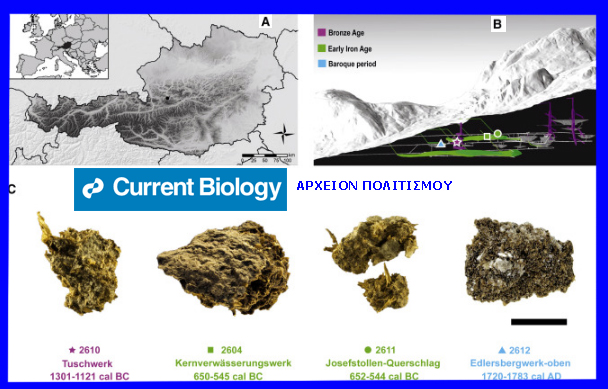
Hallstatt, φαίνεται να χρησιμοποιούσαν τεχνολογίες ζύμωσης τροφίμων με
μικροοργανισμούς, οι οποίες χρησιμοποιούνται ακόμα και σήμερα στην βιομηχανία
τροφίμων!
ΠΗΓΗ: Frank Maixner (Eurac
Research Institute for Mummy Studies), Kerstin Kowarik (Μουσείο Φυσικής Ιστορίας της Βιέννης) «Ancient poop shows people in present-day Austria drank beer and ate blue cheese up to 2,700 years ago», στο Cell Press, 13.10.2021. Και Frank
Maixner, Mohamed S. Sarhan, Kun D. Huang, Albert Zink, Hans Reschreiter και Kerstin Kowarik «Hallstatt miners consumed blue cheeseand beer during the Iron Age and retained a non-Westernized gut microbiomeuntil the Baroque period», DOI: https://doi.org/10.1016/j.cub.2021.09.031
στο Current Biology, 13.10.2021. ΑΡΧΕΙΟΝ ΠΟΛΙΤΙΣΜΟΥ, 14.10.2021.
Summary
– Gut microbiome and diet of European salt miners determined using
paleofeces
– Until the Baroque, the microbiome resembled that of modern
non-Westernized people
– Food-fermenting fungi in Iron Age feces indicates blue cheese and beer
consumption
We subjected human paleofeces dating from the Bronze Age to the Baroque
period (18th century AD) to in-depth microscopic, metagenomic, and proteomic
analyses. The paleofeces were preserved in the underground salt mines of the
UNESCO World Heritage site of Hallstatt in Austria. This allowed us to
reconstruct the diet of the former population and gain insights into their
ancient gut microbiome composition. Our dietary survey identified bran and
glumes of different cereals as some of the most prevalent plant fragments. This
highly fibrous, carbohydrate-rich diet was supplemented with proteins from
broad beans and occasionally with fruits, nuts, or animal food products. Due to
these traditional dietary habits, all ancient miners up to the Baroque period
have gut microbiome structures akin to modern non-Westernized individuals whose
diets are also mainly composed of unprocessed foods and fresh fruits and
vegetables. This may indicate a shift in the gut community composition of
modern Westernized populations due to quite recent dietary and lifestyle
changes. When we extended our microbial survey to fungi present in the
paleofeces, in one of the Iron Age samples, we observed a high abundance of
Penicillium roqueforti and Saccharomyces cerevisiae DNA. Genome-wide analysis
indicates that both fungi were involved in food fermentation and provides the
first molecular evidence for blue cheese and beer consumption in Iron Age
Europe.